IUCN threat status:

Not evaluated

Wikipedia

Read full entry

Ophrys apifera

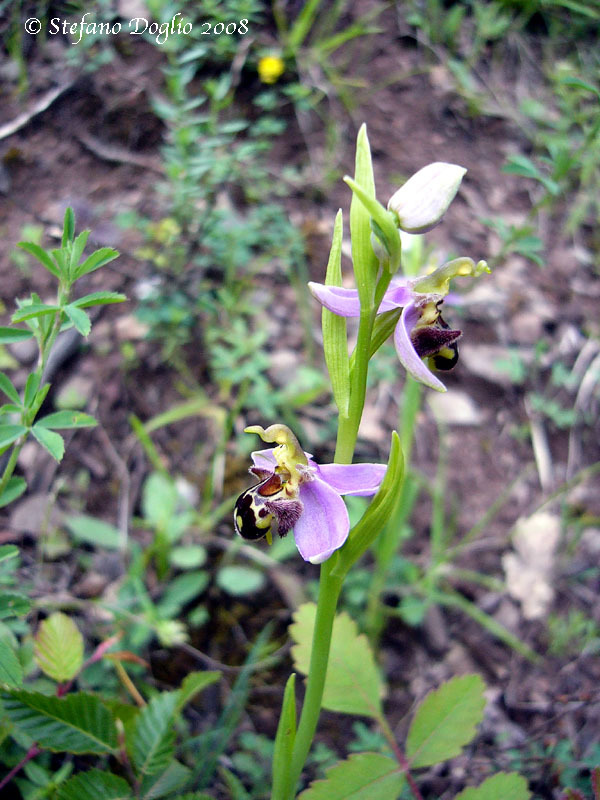
Ophrys apifera, known in Europe as the bee orchid, is a perennial herbaceous plant belonging to the family Orchidaceae.

Contents

Etymology

The name "Ophrys" derives from the Greek word ophrys, meaning "eyebrow", while the Latin specific epithet apifera refers to the bee-shaped lip.

Description

Close-up on a flower of Ophrys apifera

Ophrys apifera grows to a height of 15–50 centimetres (5.9–20 in). This hardy orchid develops small rosettes of leaves in autumn. They slowly continue to grow during winter. Basal leaves are ovate or oblong-lanceolate, upper leaves and bracts are ovate-lanceolate and sheathing. The plant blooms from mid-April to July producing a spike composed from one to twelve flowers. The flowers have large sepals, with a central green rib and their color varies from white to pink, while petals are short, pubescent, yellow to greenish. The labellum is trilobed, with two pronounced humps on the hairy lateral lobes, the median lobe is hairy and similar to the abdomen of a bee. It is quite variable in the pattern of coloration, but usually brownish-red with yellow markings. The gynostegium is at right angles, with an elongated apex.

Reproduction

It is the only species of the genus Ophrys which preferentially practice the self-pollination. The flowers are almost exclusively self-pollinating in the northern ranges of the plant's distribution, but pollination by the solitary bee Eucera occurs in the Mediterranean area. In this case the plant attracts these insects by producing a scent that mimics the scent of the female bee. In addition, the lip acts as a decoy as the male bee confuse it with a female. Pollen transfer occurs during the ensuing pseudocopulation.

Bees in the past have promoted the evolution of bee orchids. Male bees, over many generations of cumulative orchid evolution, have built up the bee-like shape through trying to copulate with flowers, and hence carrying pollen.[1]

Distribution

Ophrys apifera is a temperate climate species, widespread from the Atlantic to the Caucasus. It is quite common in the Mediterranean region eastwards to the Black Sea [2] (Codes) [3] but is less common in its northern range being uncommon or local in Germany and Ireland. In the UK, it has a distinct south-eastern preference, being more common in England, whereas it is only to be found in coastal regions of Wales as well as the Hodbarrow nature reserve in Millom Cumbria and some parts of Northern Ireland. It is relatively common in the North East of England and in recent years large numbers have appeared in the grass verges surrounding the Metro Centre in Gateshead. In Scotland it was thought to be extinct, but was rediscovered in Ayrshire in 2003. In some countries the plants have protected status. They are unusual in that in some years they appear in great numbers, then sometimes only reappear after an absence of many years.

Ophrys apifera in the foreground growing on a grass verge at The Metro Centre, Gateshead. Debenhams department store is in the background

Habitat

Orchis apifera generally grows on semi-dry turf, in grassland, on limestone, calcareous dunes or in open areas in woodland. It prefers calcareous soils, in bright light or dim light.

Culture

Ophrys apifera is the County flower of Bedfordshire.[4]

Varieties

References

  • Pignatti S. - Flora d'Italia (3 voll.) - Edagricole – 1982, Vol. III
  • Tutin, T. G. et al. - Flora Europaea, second edition - 1993

Trusted

Creative Commons Attribution Share Alike 3.0 (CC BY-SA 3.0)


Source: Wikipedia

Belongs to 1 community

Disclaimer

EOL content is automatically assembled from many different content providers. As a result, from time to time you may find pages on EOL that are confusing.

To request an improvement, please leave a comment on the page. Thank you!